A Fond Farewell
Christopher Jason Bell on 𝘐𝘯𝘤𝘰𝘳𝘳𝘦𝘤𝘵𝘪𝘰𝘯𝘢𝘭 (a film that will no longer exist in 24 hours)

AMERICAN INDEPENDENT FILM is a cruel place, maybe especially if you came of age (like I did) dreaming big during the Wes Anderson/Paul Thomas Anderson/Kevin Smith/Quentin Tarantino years, in which every miserable hack was allegedly one breakout spec script or shoestring feature away from becoming the next Spielberg.
NJ-based filmmaker Christopher Jason Bell is the opposite of a hack, but he does describe himself as miserable, and has always been up front about the many difficulties of trying to write, direct and self-distribute his own unique flavor of low-budget cinema (imbued with a clear love for neorealism, slow cinema and documentary) while also holding down a workaday job, without flashy connections or inherited intergenerational wealth. Bell has quietly built a massive body of work, and watching any of his films—a handful of which are free to watch on leftist news site Means.TV, many others of which he happily shares with anyone who’ll ask—his mordant sense of humor is immediately obvious.
The one exception might be Bell’s first feature The Winds That Scatter, a solemn meditation on the alienation of a displaced Syrian refugee (Ahmad Chahrour) trying to eke out a living in an apathetic, oblivious United States. Since then Bell has turned out a brief meet-cute romantic comedy (The City is Like a Character in the Film), directly engaged Ridley Scott’s casual Islamophobia with the short film Mohammed So-and-So), woven a staggering portrait of George W. Bush entirely from archival TV footage in the miniseries Miss Me Yet1, and delivered a stunning naturalistic portrait of life for a NYC delivery man at the margins during COVID, in his most recent feature Failed State codirected with Mitch Blummer. And more. (For my money, Failed State is, and will one day be recognized as, one of the essential films about the pandemic’s atomizing effects on society.)
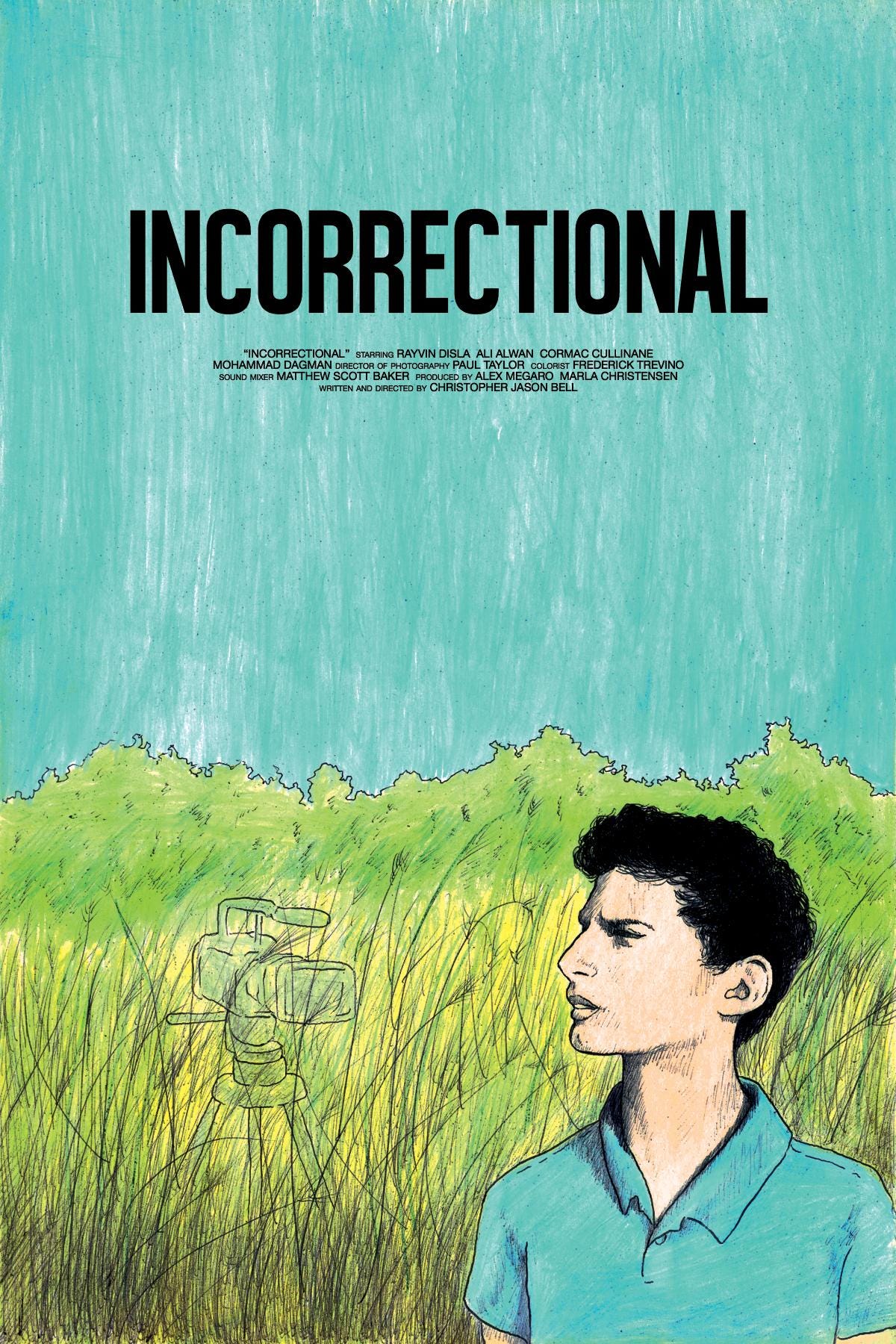
Chris is one of the hardest-working and most true-blue grassroots independent (as opposed to NEON/A24 “independent”) people making movies today. He’s also a dear friend; I caught a screening of his hilarious short Pilgrimage at a 2011 showcase organized by Kings County Cinema Society (RIP) and approached him thereafter to say how much I loved it. This evening at Roxy Cinema New York, Chris is holding a “memorial service” screening for his second feature, Incorrectional, starring Ali Alwan and Rayvin Disla as Ali and Saeed (respectively), a father and his teenage son whose strained relationship eventually demolishes Bell’s narrative in real time. It’s a bracing, droll, humanist work that deserves, and deserved, more attention. A few days before the event, I called Chris to try and understand why he was doing this.
Tonight, you will appear before and after a screening of Incorrectional. I’m assuming there is some kind of talkback. But the main thing is… you are also going to purge the film from a hard drive? From all hard drives? Just spell that out for me.
I’ll briefly introduce the film, and we’ll watch the film, and I have a eulogy planned to say after the film, and then I’m going to have other people give eulogies. I have two confirmed, and I don’t know if somebody else wants to do it. After those, then I’m going to hook up a laptop, hook up the project hard drive, and the last thing is I’ll delete the hard drive in front of everybody. I was gonna destroy the hard drive, but prices on hard drives have went up considerably in the past even few months… So I’m not doing that.
Always cost-conscious.
But I will delete it, and then I’ll, you know, I’ll clear the little recycle bin, so everyone knows.
They’ll hear that little paper crinkling noise or whatever. In ATMOS.
I think watching all of the files get deleted is going to be a very surreal, unnerving, disturbing, and moving experience all in one. It’s also kind of cool if people just get up and leave during that, in which case they’re not going to see me probably do the whole process, but I think they trust me. And I’m saying it now that I’ll do it, so I’m on record.
Are you going to sit and watch the film with the audience, or are you gonna… get a bite to eat? Pace around outside?
No, I’m gonna watch it. I don’t normally do that, but I kind of have to. I haven’t watched it since it premiered at Torino, other than file checks or whatever.
But why this film? I saw it when you first sent it to me in 2017, and again a few nights ago… It’s a nice little picture.
People have told me that they really love it. Someone said it was a masterpiece. Someone else said it’s my favorite thing they’ve ever done, and only one of those people was my wife. But the main reasons are legal ones.
I’m sad this is happening. It’s also a relief, in a weird way, to learn there’s a more solid reason than, “Chris hates the film.”
No, I lke it a lot. But I do think that this is fitting because of the general makeup and nature of Incorrectional in particular. If you watch this film and you’re like, “Oh yeah, then he deleted it ten years later” or something, I don’t think that would be too shocking.
But… you gotta explain more. “Legal reasons” could mean anything.
Well… I had an email address for the film. “Incorrectional.film” at gmail or something. I never checked it because nobody cared about Incorrectional.
How can that be true?
This film premiered at the Torino Film Festival, and then I had a screening in at Spectacle in 2018.
Part of the screenings organized by Zach Fleming, Caroline Golum and myself.
Yeah. Those were both really great, gratifying experiences. But it did not play a single other place afterwards. I tried, got close to a couple festivals, Woche der Kritik in Berlin... Same with the Champs-Élysées Film Festival. I know programmers liked it, or at least they told me they did But it was a lot of… “Couldn’t fit it in.”
I’m sorry. We’ll talk about the festivals in a second. But back to the email…
I didn’t check that inbox much after the initial run of rejections… I’m just busy, I was doing other projects. I ended up getting an email from, let’s just say, an entity. They weren’t super aggressive or anything, but I didn’t see it, so they followed up. And I think people lose patience when they’re sending multiple emails and nobody’s responding. And eventually, I was able to reply to them, but emotions were running a little higher than I would have liked.
I love “entity”, very sci-fi. What were they emailing about?
They were saying there were some things in the film that they had legal rights to. It was all totally fine, but people get upset when they feel you’re ducking them. By the time I came into this, they were already kind of pissed off. I did get legal counsel, whatever little I could afford. I also talked to some other filmmakers: “Have you ever experienced something like this?” One of them took it upon themselves to jump in and get involved, their heart was in the right place, but it kind of made things even messier than necessary. So you have emails not returned, and then you have someone getting involved who’s not part of the film. We ended up figuring it out, but it was this crazy, messy, highly emotional thing, for a film that is very personal and small, and not even in any kind of monetized circulation.
So they’re aware of the Roxy screening.
Yeah. “Can I have one last screening?” And they’re fine with it, so we settled on that.
It’s a shame though. I love this movie. I think it perfectly represents your low-key approach to filmmaking, your sense of humor, and also reflects your interest in Kiarostami, in slow cinema…..
I love Simbiopsychotaxiplasm but I hadn’t seen it yet when I made Incorrectional. The diet at that time included Akerman, Tarkovsky, the Iranian New Wave… I love Jafar Panahi, especially The Mirror.
There’s a good bit of This is Not A Film in here, too.
Incorrectional was a film that needed—like, really, really needed, institutional backing. Film festival approval, critics’ approval, whatever, to help it along and attract people who know about that kind of stuff. Nathan Fielder was active then but I feel there’s been a full resurgence of playful metadocumentaries since….
“Docu-fiction hybrids” or “metatextuality” or self-reflexiveness, it’s all the rage right now. I’m increasingly worried it’s a substitute for having a real idea, or a real story to tell, or a real idea about how to tell that story…
Incorrectional came about from watching too many new movies and being really frustrated at the lack of exploration and the lack of experimentation. I was having a hard time making something, or getting it out there, so I wanted to break apart the form and try something new. I was going against a lot of what I was seeing. It’s the 2010s, I’m having to work overnights, and in my spare time I’m seeing Mumblecore 2.0 take off in Brooklyn.
Mumblecore 2.0?
You know… Movies about white people hanging out in apartments, talking and having sex. It didn’t really particularly interest me. At the time I was actively going against that particular grain. I’m more open-minded now, but there was way too much of that stuff back then. Some of these filmmakers were more ambitious than others, and as I had my own filmmaking struggles I realized, well, they shot in those apartments, and cast those people, because it was easier. Those people were their friends. Those were their apartments!
You should have released Incorrectional in six different formats, with six different aspect ratios. To quote Christopher Nolan, “there are six suckers born every minute.” But that’s just a joke.
I was gonna take the movie on the road, but COVID hit when I was preparing to do that. So it lived online to view in full for free, for many years. I don’t think anybody gave a shit. Until the entity did.
I was prescreening DVDs for a couple of film festivals at that time, and… Because of the DSLR revolution, a random film with an absolutely terrible script was even funnier, because it now had this professional sheen that it would not have had two years ago. And of course that look is dated now.
You could get a digital camera that shot good video, and that meant it was versatile, and you could do guerrilla and get away with it because people thought you were taking still photos. Suddenly you’re seeing a lot of films that employed shallow depth of field, which meant the film was shaped around that, and if you didn’t want your film to look like that, then you were probably in trouble. So it enabled people to make a film look good in a certain way, but it also tricked them into thinking they could make something that people would appreciate, but then what ended up happening was that a bunch of films that all kind of looked good but flooded the zone. People with money were still able to shoot on film. Looking back, it’s funny how unquestioningly that look was just accepted.
I mean, film has a kind of accelerationism built into it: the newest thing must automatically be the best thing. (Must it?)
MiniDV is making a comeback now. People are exploring it as an actual tool instead of just, “this is the new best thing we have.”
Why do you think that’s happening, though?
It’s, y’know, a way to stand out. I also think the people using it are of a generation that grew up with it. Broadly speaking, it’s an image that’s ingrained in their heads, and they want to speak with it. Those who are too young to have experienced anything other than a crisper, more HD image, maybe they’re finding the nostalgia in it. I think lo-fi has a certain longing to it. And personally I think the texture of MiniDV is very evocative, very specific... If you shot something personal, that’s probably what it looked like. I mean, I think that era of digital filmmaking is really cool. Even the more upscale stuff… Whatever camera they shot Pieces of April on…
But another reason this screening is tripping me up because I’m thinking about being old, I’m talking to other filmmaker friends, and we’re all kind of doing the same thing. I’m forty now, and I ask them, can you imagine waking up when you’re sixty and getting a form rejection email from FilmFreeway or whatever? You’ve made seven features, and still nobody gives a shit? How’s that gonna feel? Thinking about the last ten or so years, it’s a really rough go. But none of us are gonna quit.
I agree. Have you kept up with Ali?
Unfortunately he died, I think in 2021. COVID. Ahmad, the lead of my prior feature The Winds That Scatter, he died of pancreatic cancer. Then Ali.
Oh God, that’s horrible.
I had a Facebook page for Incorrectional… After years of inactivity, this mysterious account started messaging the page asking if they could see the film. I was like, “Who is this?” Because it was online. I consulted with Muhammad Dagman, and he confirmed the account was Ali’s brother. He really appreciated the film, because he had pictures of Ali, but nothing in motion. So it felt really good to be able to give that to someone.
I remember Incorrectional being shared by To Each Their Own Cinema in 2024, one of those cool curated newsletters with film links and recommendations… But I know you’re used to being a one-man show, too.
Especially Miss Me Yet, I’ve been finding fun ways to get that out there. Same goes for Failed State. I just had to figure that stuff out, because I don’t have pockets full of money. I couldn’t fourwall my own screenings even if I wanted to. And… Incorrectional is my most personal movie. I took it all very personally, the struggles to get it made, to get it shown, and now this. But this also enables me to do something different.
The eulogy.
Right. It creates a little urgency at least. It’s part of the film’s life, a weird little history. Not to sound grandiose or anything… Even though it’s sad, it also ties in with what I was trying to do when I made the film.
Say more?
Because the film breaks down about halfway, coming back together in a different way, through the structure of it. I wanted a film where the character turns and looks into the camera and says something that tips it into documentary. I wanted the fourth-wall-breaking to replicate this feeling of a nasty fight, between a father and his son. Rote subject matter but the real thing can be incredibly shocking to watch. That’s something we all have had, with whatever family member. Can we bring that back? Can we bring that passion? Can I tell it in a new way? And that was really exciting.
The replication being your disagreement with Ali, the actor, who calls it quits halfway through shooting a scene.
Ali was a pain in the ass. But he was great. And I was like, “He’s being great in this moment. He could fight me on-camera, as the director.” Because we got on each other’s nerves in real life, this was a chance to collaborate on a deeper artistic level. Ali can tell me what he wants to do. You set the parameters. Here’s the sandbox, and you give them the power to do whatever they want within that. And what he did was, to me, really incredible. I’m sure I annoyed him too, by the way. I’m an annoying guy, you know?
That’s not true.
Later in the film’s more straightforward documentary portion, I’m following him and he’s constantly asking me if it’s a real film. I didn’t tell him to do that, but that’s fucking awesome. I loved that. I loved editing that. It’s really funny. That was all him. I didn’t tell him to turn to the camera and ask me if we were actually shooting a movie. That’s weirder than I can ever come up with on my own.
“Representation” usually refers to how one character, or a small number of characters, reflect back on their attendant communities, or groups, beyond the film or media in question… In Incorrectionnal you’re exposing the perils of representation in an interaction between two people.
I really wanted people to go into Incorrectional as blind as possible. I wanted them to feel everything was really happening in reality. Part of the fun is figuring out who would question whether something was real or not, and if that even matters, as an article of faith…
This is a fundamental tension for me. Somebody will say “Shoot a movie in your apartment! Cast your friends as thinly veiled versions of themselves!” Like, bro, that’s not why I go to a movie. I wanna get outside my world, not deeper into it…
I do think there is a part of the representation conversation that never gets brought up. And that’s the fact that you are pulling together people from different walks of life and collaborating with them. There’s some form of solidarity there, especially when the dynamic on set is not super rigid. But what avenues exist for a low-budget, intentionally artistic film, in America? Incorrectional just sat on Vimeo for years. This is why I’m making a horror film next: even if it sits there untouched for years, it’s an easier pitch.
Anything that gets made for less than $300 million is gonna need to be a horror film, a true-crime film or a biopic. (Is Showtime gonna be all three?)
Or something with a recognizable lead. Which I’m open to.
To your earlier point: forty isn’t that old, in a lifespan, but I suspect we’re both feeling our age. I’m pivoting to hand-drawn, 2D comics, because that’s something I can control, theoretically, and do faster, theoretically, than making a film. But your dreams and attitude have always seemed very realistic to me…
And I’ve been miserable for twenty years. (laughs)
Well, I’ve known at least one filmmaker I would call successful for almost as long; no names. We catch up only every so often, and to hear them tell it, it’s always doom and gloom.
Two lessons there. One is that you’ll never be satisfied. It’s always going to be: “I could have used this other thing” Or “This person slighted me.” Maybe you’re always gonna feel that - and that’s real! But the other lesson is that you should be careful who you’re complaining to… Personally, I’m on my fifteenth film right now, and it’s probably gonna be another year before a film festival can say yes or no. And I’m just paying people out of pocket to tell me yes, or no.
I’ll keep it vague and say I know programmers exist who actually watch films in full, in good conditions, but the FilmFreeway, Withoutabox, Vimeo, speed-watch industrial complex is real. And it’s not meritocratic.
But even if they say yes, it’s uphill. I make a film for $10K and I’m up against something international that got tens or hundreds of thousands of dollars in state support?… That’s gonna have more polish. Nothing is more depressing than the “art film landscape”.
I always think about Coppola’s “little fat girl will be the next Mozart” comment from Apocalypse Now. The liberation and democratization of media. Which is kind of accurate but he didn’t foresee, or didn’t warn us, that a huge variety of people, talented and untalented, would make stuff that just sits there, and a very very small percentage is what actually gets programmed at festivals.
On social media people say: Go out and make your film. They’re selling you a dream of making it to a prestigious film festival that looks and feels a certain way. What if it never happens? You have to constantly reckon with your own craziness in trying to make something, even before you’re worried about it connecting with people.
Back to Incorrectional for a sec: after the narrative implodes, there’s a scene where Ali and Muhammad are talking about the Arab Spring, with real skepticism. As long as I’ve known you, we have shared an interest in geopolitics. “Failed state” is literally a term of art for those Washington D.C. think-tank vampire types. What’s the story there? And are you aware it’s box office poison?
We were talking about wanting to collaborate with people outside your vicinity, not just Brooklynite twentysomethings. That film already existed so… I wanted to see where my other interests were. In the 2000s and 2010s the cliché was, “They hate us for our freedoms.” Didn’t make any sense to me so I started reading more, about Islam, about Palestine, imperialism, anti-imperialism, other economic systems… And that ends up informing the kind of films I want to make, which always have an element of class. So for Winds That Scatter I collaborated with a middle-aged Syrian Muslim man, shooting in 2012, right after the Syrian Civil War.
And still in financial-collapse territory. For years I was fond of saying the Great Recession never actually ended, unless you’re Jamie Dimon or whatever.
Right. So Incorrectional was born of all these things. I was a film critic at the time too, right? So I was seeing lots of different stuff. I was meeting some filmmakers because I had bills pay, I had to work a lot, and I realized some other filmmakers didn’t have to work at all to pay the bills. I understood class politics through that as well. And yeah, I got to a point where I was working overnights on the weekends, and I was shooting Winds at the same time. And I was in post production on Winds, and I really felt exhausted. I was aggravated at seeing a lot of films that were not really adventurous or ambitious, and that’s when I conceived Incorrectional. “Wouldn’t it be cool if there were a film that did this?” Similar to Miss Me Yet: you start off with Bush doing these shitty things, killing 100,000 Iraqis, and it ends with him on Ellen. I was thinking about it so much it became, “Well, I guess I have to do it myself.”
That was a weird time. All that can be said about it right now is that I don’t know how real those uprisings were, and it’s kind of it’s just a huge lesson in: Where does a story come from? How are you getting it? Does it conform to what you wanna hear? Looking at all of those countries in the quote-unquote Arab Spring, I don’t know but I don’t feel certain any of them are in a better place. If we can look historically at color revolutions, which are more or less made to look like genuine uprisings, years later you learn the West may have been putting a thumb on the scale. I wanted to include all of these things and how messy they are. And I think people still have a very odd look about the Middle East in general, and maybe it’s slightly improving, because of what’s going on in Palestine. Sadly..
Politically, this is the most despairing time I can recall in my lifetime. Maybe it’s not all America’s fault, but it’s bad-bad. We’re through the looking glass. At the same time, the possibility that DSA candidates can win insurgent races and push the Democratic Party to the left is legitimately exciting, but I have a ton of skepticism about the likelihood of that actually happening. The co-optation and watering-down seems inevitable.
The more I read and learn, the more tangled everything seems. It’s just going to be very hard to untangle entrenched power of capital, and that’s really what we need to do. The Democrats used to be, then pretend to be, the party of the New Deal…
The majority of them are proudly to the right of Eisenhower, now. A lot of my graphic novel is trying to deal with this.
Yeah, although I think they still love to hearken back to that as a good thing, as if they’re the same people ideologically, and they’re not. The problem with the New Deal is that this social democracy relied on a deal between organized labor and corporations. When the profit margin was getting slim, and wages were too high, and the companies weren’t making enough money, when you saw a big push for deregulation, you saw globalization. You saw financialization. Which is what ends up happening if you’re not going to fight against the actual system. If you’re making this kind of compromise, which is social democracy, you’re going to get to a point when they’re like, “Well, wait, profit is what matters. Capital is what matters. So if this isn’t making money, what are we doing here?” Some of the programs being advanced may only help people for one or two years, and I support that. But the fundamental change is what needs to happen. Nobody agrees on how we’re going to do it, and nobody agrees that we can do it. But I try to be optimistic that whatever is getting done is a step in the right direction.
Back to Incorrectional: is the film a happy memory for you? Or is it a relief in some sad way you’re taking it out back and <gunshot noise>?
I’m upset. I think people would dig it. I don’t blame them for having no idea who I am. I wish it had found its audience. But I’ve also had people say, “Hey, it’s really cool what you did with this movie.” People with no reason to lie to me or butter me up at all. So I do appreciate that. Getting footage of Ali to his family, that’s important too.
“Important” doesn’t quite describe it… Listen, I’m at work, I need to go downstairs in a few minutes and meet Rob Tregenza (another indie maverick, whose new one, FAST, is also an inside-out movie about its own making, or lack thereof…) Can you explain what just happened with Miss Me Yet? Why did it get taken off Letterboxd?
Earlier this year, I got messages from The Movie Database (TMDB) saying, “We’ve changed our criteria for what we allow on the website, so we’re taking down Attention Shoppers”-which is another archival film I made-”and we’re taking down Miss Me Yet.” They also took down an experimental short I made, but that one was fine. Miss Me Yet is a pretty big deal for me. A lot of people saw it, and it’s got an easy hook. Its presence on these websites allow more people to hear about it and see it, as well as my other stuff. I wrote them back and explained, “I need this.” They never responded. TMDB took them off but they survived on Letterboxd.
Which is a bigger deal anyway.
Yeah. But I’m not one to check reviews of my movies on there.
I’ve been having fun with it—I recently logged Out to Sea, My Fellow Americans, Grumpier Old Men and I’m Not Rappaport all on the same day—and I know it’s a helpful place to gather links to stuff. But I also gotta say I kind of hate what Letterboxd is doing to film culture. (Maybe film culture was always terrible.)
It is really nice to get reviews, and it does help people see stuff, hear about stuff. I have gotten other people asking for a link to Failed State or getting interviews for Miss Me Yet, because they saw somebody log it on Letterboxd.
Those are real positives. But sometimes I tell filmmakers, “Don’t look at the peanut gallery on Letterboxd. You already made a goddamn movie, which is huge. Work on your next movie!”
If somebody sends me a positive review that they wrote, I’ll clip it and I’ll spread it. But I don’t need the psychic damage of checking a bad review. My life is miserable enough. Anyway: last week a friend told me Miss Me Yet was no longer on Letterboxd. Which means that because TMDB took it down, eventually Letterboxd did too.
It’s worth noting, Letterboxd used to source its information about titles from TMDB. And Letterboxd did not take down Carlos or Berlin Alexanderplatz.
Nope. And there’s lost films on there, stuff that cannot be seen anywhere, and people are logging it. Very strange to see them assert a strict criteria suddenly. You can’t say it’s about film history if you’re also doing that.
Right. I mean, I definitely will file a complaint and encourage any readers to do the same. I also wonder if it’s connected to the rumored sale in Letterboxd’s future…
Having my work on Letterboxd has been a net positive for me, and I’ve tried to build off that because I don’t know what else to do.
Personally, I think you’re on the come-up. But it’s a slow burn. When we showed Failed State at Spectacle, tons of people came, well beyond the cult of Chris Bell, and I’m no mind reader but it felt like it was hitting. And you’re one of the most prolific people I know. Always working on something. How do you learn from all these experiences without bitterness?
I’m insecure, and I dwell on a lot of stupid shit. But this has caused me, for obvious reasons, to reflect a lot. It’s the sunk cost fallacy. If I don’t write, I’ll go crazy. I’m going through footage and editing for an archivall project, and this is basically the writing process, but it’s in the editing suite. And I realized because I wasn’t actually writing, that it was making me go crazy. I need the act of actually writing and conceiving, on paper.
You’re 40, I’m 39. After over a decade of failing to get programming jobs, writing criticism for pennies, running myself ragged organizing screenings for free, watching Spectacle go in a wildly different artistic direction than what we built in the 2010s… Nothing was more liberating for me than when I started drawing They Saved Biden’s Brain. But it’s also been kind of awesome to try and disabuse myself of younger, more naive expectations, and just let that stuff go. Clearly I’m still trying. But there’s something about doing a thing just to do it, not because you think it’ll produce a specific outcome.
Why am I feeling bad about a movie when there’s people who literally can’t eat today, or they don’t have a place to live because of the system we live in? And I’m sad about a movie I made?
There’s no getting around that, though, Chris.
My thing is, I have never felt more like I wanted to quit than in the last few weeks. But that’s probably because I was not taking enough vitamin D, and it’s probably because I am doing this screening.
Don’t quit.
I won’t. What the fuck else would I do?
Current Mood: Solemn… 😑
Current Music: Angelique Kidjo - Born Under Punches
I interviewed Chris for The Baffler in 2023, when Miss Me Yet first became available online.