The Burning Brain
a conversation with Guillermo Arriaga about 𝘛𝘩𝘦 𝘛𝘩𝘳𝘦𝘦 𝘉𝘶𝘳𝘪𝘢𝘭𝘴 𝘰𝘧 𝘔𝘦𝘭𝘲𝘶𝘪𝘢𝘥𝘦𝘴 𝘌𝘴𝘵𝘳𝘢𝘥𝘢 (and much else)

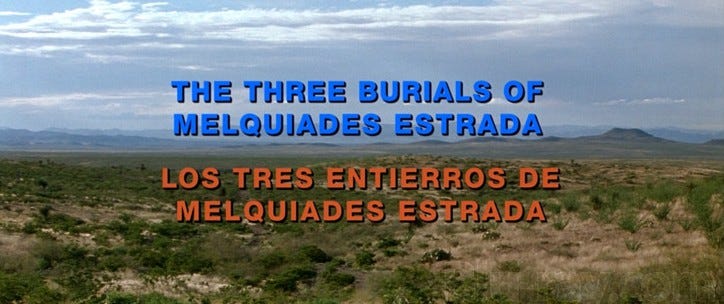
TONIGHT AT 6:45 PM, “The Baffler Presents: Global Texas” kicks off at Brooklyn Academy of Music with a rare 35mm screening of Tommy Lee Jones’ 2006 directorial debut The Three Burials of Melquiades Estrada. Last night I had a long discussion with screenwriter Guillermo Arriaga, ZOOMing in from his home in Mexico City. Beyond his work as a screenwriter and director, Arriaga is a decorated novelist and cineaste. (His 2023 screenplay Upon Open Sky was made into a film by his children, and is now available in English via Sticking Place Books.)
Even if you cannot make our screening in Brooklyn tonight, I think a lot of what he says is valuable, especially regarding the relationship between Mexico and the United States. Our conversation has been edited for clarity and flow.
I appreciate you making the time for this, Guillermo, and I’m sorry for bothering you on WhatsApp these last few weeks. Our mutual friend Fernando Llanos told me you might be busy with the World Cup.
Well, it’s true I’m obsessed with the World Cup. Right now my son is in the other room waiting for me to finish so we can watch the match between Paraguay and Germany. I’ve also been traveling a lot, so I’m not always available. Recently I’ve been in Italy and the Dominican Republic to promote a new book. I’ll be traveling to nine countries in total, as of right now.
Any plans to visit New York?
I’m avoiding the U.S. for a bit. If it’s not absolutely necessary to travel there these days, I’ll wait.
Understandable. Well, I hope tonight’s screening is the first of many 20th anniversary revisitations for The Three Burials. I saw this movie in theaters and was just blown away. There’s not too much out there about how it came to be. So let me open with a broad question: how did you and Tommy Lee Jones get linked up together?
It was a process of many years. In 2001 Tommy Lee called me, because he had seen Amores perros. He wanted me to adapt a film for a remake—I can’t remember which. I was going to travel to L.A. to meet with him, and my plan was to tell him in person that I do not adapt other people’s films. I want to write original screenplays only.
Now, Tommy Lee thinks of himself as bilingual, but he really speaks very little Spanish. So I’m in L.A. and I get this phone call: “Hola, Guillermo! Se habla Tommy Lee Jones!” He tells me he wants to work with me even if it’s on a different project. So we go out for dinner. I need to get an idea of his taste, because everything in this business is taste. If you’re working on something that has nothing to do with your taste, it becomes a nightmare. So I ask him: “Who is your favorite film director?” He turns around and points at this watercolor painting on his wall. It’s a picture of a samurai. He says, “My favorite director is Akira Kurosawa.” Kurosawa did the painting. I say, “Wow. Who is your favorite living American author?” He says, “Cormac McCarthy.” Well, that is my answer as well. I ask him, “Do you like hunting?” He loves hunting. He says, “I have a ranch, I’ll invite you.” So we go hunting. I’m thinking, I can work with this guy. I tell him the story of Melquiades Estrada. He says, “Okay, write it.”
Just like that?
Well, his only thing was, “I want to be the protagonist.” Which was great with me. But I don’t just write a screenplay and hand it off, I’m very involved in the production as well. I was involved in casting all the Mexican actors, along with producer Michael Fitzgerald. I helped scout locations, I was there for the shoot, and I appear in the film as well. I was very close to this project, and I’m thankful to Fitzgerald, Tommy Lee, all the people involved.
Cursory internet research suggests the story was inspired by Esequiel Hernández Jr., a teenager (and U.S. citizen) who was murdered by U.S. Marines near the border in 1997.
This movie is not an adaptation or a response to what happened to Esequiel Hernández. It has to do with people I knew from my own life, brothers who are the protagonists of my novel A Sweet Scent of Death. These guys are very poor Mexican farmers. They cannot read or write. I have known them for many years. I am still in touch with them. One of the brothers died, but I spoke to the other just a few days ago. He is still working in the United States. Very decent people. The film is an homage to them.
Tell me more about how their stories are threaded into The Three Burials?
One friend of mine crossed into Texas to work, so he could send money to his wife and kids back in Mexico, a very common situation. Eventually his wife crosses the border as well, and suddenly he stops hearing from her. No news, nothing. He decides he won’t cut his hair until he hears from her. One, two, three months go by. He’s crying. He thinks she’s abandoned him. A year and a half later she reappears, and the reason is because she used a fake passport. You must remember, back in the 1990s at least, it wasn’t a crime to cross the border into the United States. The crime was to do so with false papers.
So in The Three Burials, you see a guy with a phone in his store, charging customers per phone call. It’s because my friend’s wife was in jail and she had the option to make one phone call. This is before cellphones, or these people don’t have cellphones they can afford. Let’s say a woman calls for her husband and he’s not there, and the shopkeeper forgets to tell him she called. So he has no idea what’s going on. That’s an example of real incidents that inspired my script.
Obviously Tommy Lee was and still is a seriously respected Hollywood actor. This was his first theatrical feature. Did you have carte blanche to write whatever you wanted? Was there any studio involvement? Rewrites, complaints, things you were obligated to include?
This movie was financed completely by Luc Besson. You may think of him as a director but he is, and was, very active as a producer in those days. At the time I was on my world promotional tour for 21 Grams. Tommy Lee called me and said, “Let’s go seduce these guys.” He knew Luc Besson loved diving. So we went to the Bahamas with Luc, Michael Fitzgerald, another producer named Pierre-Ange Le Pogam. These guys said, “We will respect absolutely what you and Tommy Lee have in mind for the film.”
The movie is conversant with mythic frontier tropes, cowboy stuff, et cetera, but the depiction of border town culture is also quite detailed. Dingy. Lived-in. The commingling of Mexico and the United States is presented as a fact of life.
I’ve been obsessed with the border since I was a kid. I think I know every crossing location in the United States and Mexico, even the most remote ones in New Mexico and Texas. I love the interaction between the two cultures. It’s far deeper than anyone can imagine. Shooting the movie, we were at a bar in Texas with a band, and they were alternating: one hour they would play Mexican music, the next hour they would play American honky-tonk music, and so on. Mexican cows were mingling with American cows. Illegals with citizens. They are very, very, very close, and not as different as people would like you to think. So I wanted to portray that world which I love, and a profound friendship between two characters, a Mexican and an American. I did not want to make a “political film”.
Say more about that.
I’m not just obsessed with the border, I’m also obsessed with racism. But it has nothing to do with the political climate, not 20 years ago or today. The context of a story is what makes it political, not the intent of the author.
I went back and listened to a talk you did in 2006 where, talking about teaching writing classes, you warned your students not to try being deep or profound.
Because it doesn’t mean you will not be profound, or deep, or that you cannot be. But your job is not to be “deep” on purpose, your job is to tell a story. If you are deep, the story will be deep. If you are shallow, the story is going to be shallow.
I’m not interested in political statements, but human ones. I don’t want to make propaganda. And by the way, I am very thankful to the United States, a place which has given me many jobs and where I have been very respected. Nobody ever questioned my nationality or right to be there, even if I was directing Hollywood actors as a Mexican. When I was shooting The Burning Plain, Jennifer Lawrence was constantly mocking my accent, my poor English. But it was all in good fun.
For those too young to remember the General Agreement on Tariffs and Trade (GATT) and the North American Free Trade Agreement (NAFTA), can you talk about how American trade policy affected your life in Mexico, and/or the Mexican film industry, back in the 1990s?
In Mexico it affected the sectors that had no chance to compete with their equivalents in the States. I saw that in real time with my friends who inspired The Three Burials. The state of Tamaulipas, in the north, borders Brownsville, in Texas. They had the best sorghum crop in the world, but when the agreement opened the borders for the products, they had no way to compete with subsidized agricultural products from the States. So all of them went bankrupt. And they were already very poor. This is the reason why 80% of that family migrated, or tried to migrate, north. I have one friend who asked me to be the godfather to his kids. He migrated when his wife was pregnant. He didn’t meet his daughter until she was seven years old. And this is also why the cartels began gaining power. If there are no opportunities for anyone, then black market stuff, drug dealing, becomes your best option to make money. So that’s where it comes from in The Three Burials, me seeing how lives are being changed across these three worlds. There’s a jealousy aspect as well that’s in the film.
Jealousy?
Well, families can disintegrate under this pressure. No one talks about this, but let’s say a man goes to the States in order to work, and his wife is afraid he’ll take up with another woman when he is there. He sends remittances to his wife in Mexico without knowing if she is with another man. You need a strong bond of trust between husband and wife to make that jump. I have a friend whose grandchildren do not speak Spanish at all. When they came to meet him in Mexico there was no way for them to communicate. Stories like this. And the NAFTA era led to an explosion of migration from Mexicans, but the more recent border crossings are almost all people from other countries: Haiti, Cuba or Venezuela, for example. Mexicans get blamed for everything but during the “catastrophe” of the Biden years, almost none of the migrants were Mexican.
This film was released during the same awards cycle as Babel, directed by Alejandro González Iñárritu and written by you. Were you involved in both productions? How would that work?
I was shooting The Three Burials while Babel was in preproduction. I had been intensely, intimately involved with the filming of Amores perros as well as 21 Grams. But Babel is the only film I have written where I wasn’t on-set for production, because of my huge falling out with Alejandro.
We don’t have to get into it if you don’t want. But you guys haven’t collaborated since, if I’m not mistaken.
I was completely shut out of Babel: the production, the promotion, everything. But after almost three years of not speaking with each other, Alejandro and I met up recently and talked about all of this.
Babel came out alongside Pan’s Labyrinth and Children of Men, and those who were paying attention at the time will recall Alejandro, Guillermo del Toro and Alfonso Cuarón being labeled “the three amigos”. This really bothered me, especially having seen the Disney film that moniker references. On the other hand it was exciting to see gringo audiences turning out in droves to watch these movies by Mexican filmmakers in American multiplexes. What are your thoughts on that?
People paid more attention to these three Mexican directors but there are many who have been successfully working within, or in collaboration with, the United States. The integration between the respective film industries has continued. Look at Michel Franco shooting Chronic with Tim Roth in 2015, for example, or Alonso Ruizpalacios shooting his 2024 film La cocina with Rooney Mara in New York City. Fernando Eimbcke shot his film Olmo in Las Cruces, New Mexico.
Is it a net positive, in your opinion? Or has this chance to get American dollars, or work with American actors, diluted Mexican films?
It’s a good thing. Mexico is the most important economic partner of the United States. Most of their products are sold to the U.S., and the U.S. sells most of its products to Mexico. The shared economy between the two countries is almost a trillion dollars. We are neighbors. Nothing is going to change that.
To pivot slightly: I’m curious to know what your regimen is as a writer. You are perhaps Mexico’s most celebrated living novelist. You had published several books before your first screenplay, Amores perros.
I came into cinema as a novelist, yes. Producers began buying the rights to make my novels into films. Cuarón wanted to do A Sweet Scent of Death well before my work with Iñárritu. He wanted his sister to adapt the book, and his brother to direct. But the project crumbled and ended up in the hands of a lesser director. A very good director, by the way, but not on Alfonso’s level. If you see my films you can tell they are heavily influenced by literary structures.
I assume you’re referring to the non-linear, fractalized structure of the Inarritu trilogy…
Yes. Because this is how we tell stories in real life: we jump around. We don’t go linear when we’re speaking to one another in real life. As a screenwriter I am more influenced by Faulkner, or Joyce, or Virginia Woolf, than I am by other movies. I was very hurt, for example, how many critics alleged the structure of 21 Grams had been determined in the editing room. Of course I was happy when Stephen Mirrione won an editing award at the Venice Film Festival, but that aspect was always there in the writing.
How does writing become difficult for you?
Well, my last couple novels were about 700 or 800 pages. From the first word on the first page, I rewrite each of them completely. I transcribe word by word. I’m making corrections but also rewriting. If I’m not changing the fundamental structure, then I am cutting out words. I hate repetition of words. I hate cacophonies. For me the distance between characters means everything. It’s not the same if I say to you from 10 meters away, “I’m gonna kill you.” This is quite different from (pulling his face close to the phone camera) whispering, “I’m gonna fucking kill you.” Right?”
Definitely. But how do you decide on what you want? Outlines? Rearranged index cards?
I do not plan these things out in advance, neither my novels nor my screenplays. I improvise when I write. Whatever comes to my mind at that moment. I don’t know how to logistically organize this process, I just allow the novel or the screenplay to reveal itself to me, for my unconscious to dictate whatever it is I have to say.
In a 2016 interview I did with Paul Schrader he said, “I’m not a real writer… I’m a binge-writer. A real writer writes every day; they say you should do 500 words in some format or another, at least. A real writer can write a book for years on end; a screenwriter does something in six weeks.”
But I consider the screenplay a piece of literature and spend almost as much time on it as I would a novel. I’m a perfectionist. I take care with the language and structure, the pauses, the lines, the cadences. I have the weight of every silence, every movement, and every word already down on the page. It’s a question of style, and style is how I end up rewriting or restructuring what I have already written. If Brad Pitt wants to work with Iñárritu, and I send him Babel, and it’s not good enough for him, or it’s not good enough for the president of a studio, they won’t do it. So I need the screenplay to be as intense and beautiful and powerful as possible. A screenplay is your first, last and best chance to seduce someone.
What if a producer rolls up to your house with a wheelbarrow of money and says, “I want to adapt one of your novels into a film?” Is that a nightmare? A writer friend and I were recently talking about the best-case scenario which is, a novelist is paid for the option but the movie never gets made and the rights revert back to them. Or the movie gets made but nobody hears about it, it’s buried, and the novel’s reputation is untainted.
I will follow Hemingway’s advice: “Take the money and run.” I just optioned a novel which has not yet been translated into English, but it’s been a huge success in Spanish-speaking countries. It’s going to be a streaming series and I have nothing to do with the production itself, I’m just waiting to see what they do. But yeah, I’m very good at negotiating deals. I find I must be very tough.
And back to your work with Tommy Lee: why is it that you didn’’t want to adapt or remake somebody else’s film?
It’s not my world. It’s not what I have to offer. I have been offered some big, big projects and I have rejected all of them. People I admire deeply: Faulkner, Hemingway, everyone. I refuse. Even if I am tough negotiating these deals, it’s not because I want to make money. If that was my intention I would say yes to these proposals. I’m interested in creating a body of work.
Your body of work can be quite brutal. I thought Amores perros and 21 Grams would prepare me for The Three Burials, but I’ll admit I was scandalized seeing it in the theater as a teenager.
It may surprise you to hear this, but I’m a very happy man. I’m not tortured. I’m not grumpy. When people meet me, they can’t always reconcile my work with the person I am. They ask, “Why do you have such-and-such themes in your work?” It has nothing to do with me. What are the mechanisms of the conscious mind that lead to these decisions? It’s true I had a very tough childhood because of the streets I grew up on. But it didn’t create a traumatic experience which I could not overcome. For me the idea of exorcising your demons or traumas in artmaking is bullshit. Your unconscious makes these choices and I don’t know why it happens, but it does.
Your Wikipedia page says you are a teetotaler.
Yes. I have never drunk alcohol in my life. I have never done any kind of drug, not even marijuana.
Why is that?
Well, I’m a man of extremes. I refused because I wanted to do things that people would only do when they were drunk, actually. I come from a neighborhood where, in order to be a man, you had to drink and do drugs, and so I said: “I’m going to be a man without any of that. And I will be more crazy sober than you guys are with drugs or alcohol.”
One of my dreams is to write a critical biography of Dennis Hopper, not just as an actor but also as a photographer, filmmaker, art curator, connector of people. He’s usually written off as a raving maniac, and of course his substance abuse problems were legendary before he got sober in the late ‘80s. But he regularly maintained that the alcohol, cocaine, the LSD, it was for work, because he was trying to function at this level of insane productivity. His obsessions and his ideas were his own, they weren’t just drug-induced hallucinations. Anyway: I spoke to a screenwriter who worked with him on Backtrack and she said he was even crazier sober than before.
I knew Dennis, actually. I met him in Las Vegas. I told him how much I loved his film The Hot Spot. He called me and asked if I would write a film for him to direct. I went with a friend of mine to stay at his house in Venice Beach and work on the screenplay. Dennis had masterpieces by people like Basquiat, Warhol, all these guys.
Probably this is the house he had designed by Frank Gehry.
Spectacular house. An architectural marvel. Anyway, soon I got a phone call: Dennis has been taken to the hospital, but that’s all I know. After he gets out, he tells me, “I have cancer, but I’m gonna be okay.” I tell him, “Once you are healthy, we’ll make the film.” We had the financing and everything. His son was going to be the lead. This was in September 2009. He died in May 2010.
Can you say anything about the plot?
No, I’m holding onto it. I want to save it.
Fair. But why do you love The Hot Spot so much? Even among Hopper fans it’s considered a lesser work… I think a lot of people object to how sleazy it is.
It’s a bit like The Last Picture Show by Larry McMurtry: the quintessential small Texas town. But Dennis’ version is more asphyxiating. The heat, the chemistry between Don Johnson, Jennifer Connelly, Virginia Madsen… The music by John Lee Hooker, that’s what I love. It’s a great film. The Hot Spot is why I wanted to convince Dennis to make a last film, and why I wanted to produce it.
The Three Burials is kicking off a selection of four films about Texas. Are there other movies you think capture Texas accurately?
Well, you mentioned Lone Star. I would also say Giant. I know Texas very well, all of it except the Panhandle. But Steve, have you ever been to Mexico?
Just once, as a kid. I was with a bunch of Christians who were doing some missionary day trip in Ensenada. They helped build a house in a slum over the course of a single day. To be honest they seemed just as focused if not moreso on getting tacos and margaritas at this tourist spot afterwards. I came away feeling a bit ashamed of myself.
Tarantino stayed at my place when he was working on the script for Django Unchained. I showed him around town and he said, “This is nothing like what I envisioned in my mind. I thought it would be a chaotic, dirty place, everyone honking, stray dogs everywhere, smoldering barrels emitting toxic vapors into the air…” You should come to Mexico City. You’ll be very impressed.
I really want to. I’m also aware there has been an invasion since COVID, Americans working remote jobs while living in Mexico City especially.
Even before COVID, but yes. Right now Mexico is full of Americans. The prices of homes and apartments, the rents, have all been raised by these Americans and Spaniards.
Back to Tarantino for a moment: I know a lot of people claimed Amores perros was influenced by Pulp Fiction.
Quentin is someone I respect a lot, but that pissed me off. I would say, “Man, the world is bigger than the United States!” I was much more influenced by a Mexican film by Jorge Fons called El callejón de los milagros. If I have any American influence, again, it’s going to be Faulkner. My great influences are Faulkner, Shakespeare, and Juan Rulfo.
And Coppola.
Really, Coppola?
Yes, specifically the two Godfathers. I pretend the third one does not exist. In my world it was never made. And I love both of them, but when I was nine years old I saw The Godfather: Part II specifically and said, “I must write something like this. I must direct something like this.”
We’re aligned on that. Since you mentioned Jorge Fons, though, I’m curious if you could tell me any other Mexican filmmakers who are important to you. I’ve programmed some films by Felipe Cazals, and was lucky to interview him before he died in 2022, but his work is mostly inaccessible here in the States. Same goes for Arturo Ripstein.
I grew up with Ripstein and Cazals’ films. These were hugely important directors in the 1970s. And maybe you know this already but Alfonso Cuarón worked as an assistant to Cazals. Servando González is another crucial filmmaker for me. I watched his film Vento Negro five times in a row, it was a big influence on Amores perros.
Can you speak on the relationship between The Three Burials and No Country For Old Men? Maybe this is a problematic question. To me they have similar themes and milieus, and obviously Tommy Lee headlines both of them. But it’s always been a bit unfair how much more attention goes to the Coens.
I love both of these movies. No Country is another instance of a film I saw five times in theaters, while I was in Portland shooting my directorial debut The Burning Plain. We had some days off so I went to see it again and again. For me it’s a masterpiece.
But to answer your question: The Coens saw The Three Burials and decided they wanted to make something like that. It’s also why they cast Tommy Lee.
Really?!
Yes. As I mentioned, Tommy Lee is a huge fan of McCarthy. He actually had Blood Meridian in development for many years, and the plan was for him to play The Judge.
Sounds amazing…
You know Cormac McCarthy lived a very reclusive life. A lot of No Country was shot in a town called Las Vegas, but it’s the one in New Mexico. But years before No Country, Tommy Lee went there. I guess he was heading towards a diner to eat dinner or something. Some guy pulls up in a beat-up pickup truck and yells to him: “Tommy, come here!” The way Tommy Lee explained it to me was, “Either this man is crazy, or he’s more important than me.” So Tommy Lee walks over to see what the deal is. “What do you want?” The guy replies, “I’m Cormac. Don’t eat at this restaurant. Come have dinner at my house instead.” And meeting Cormac had been one of Tommy Lee’s dreams.
This sounds like something from one of his novels too.
It’s a shame he didn’t get that Nobel Prize.
I’m gonna wrap up, but one more question. What is the worst American film made about Mexico?
(Long pause) There is no one film, but I absolutely hate the way Mexico is always yellow. There is some color filter they started using for Mexican scenes. It’s ridiculous. When you see Mexico, Steve, you will realize it’s not yellow.
Steven Soderbergh is a filmmaker I respect, with many works I love dearly. But I worry he opened a pandora’s box with that filter in Traffic…
I’m rewatching Breaking Bad and every time they show Mexico it’s with this damn filter.
Enjoy the football match, Guillermo. Thanks for agreeing to do this. I hope we talk again sometime.
No problem, my friend.
Current Mood: Stunned 😲
Current Music: Benicio del Toro - Shake, Rattle and Roll
Special thanks to Fernando Llanos and Guillermo Arriaga.